


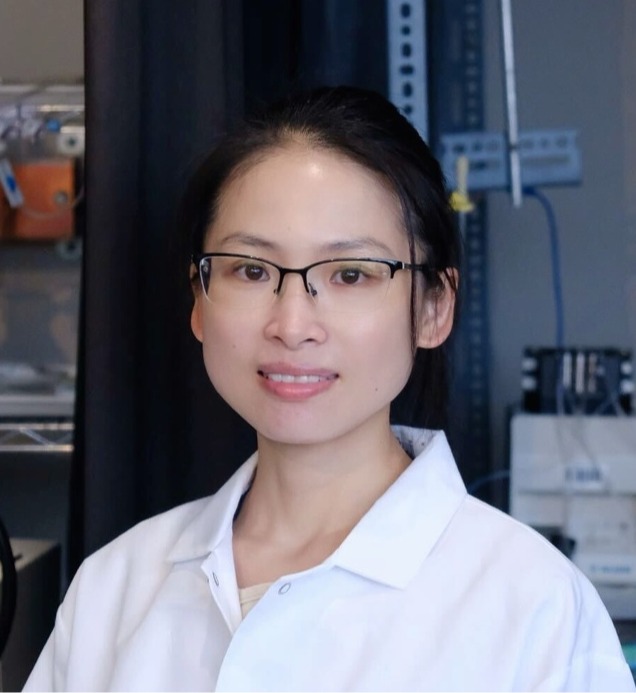
Investigator
Email:qiufenjiang@sjtu.edu.cn
Laboratory for Thalamic Information Processing
Dr. Qiufen Jiang received undergraduate training at Xiamen University and subsequently conducted master’s research on the immunoendocrine system of mollusks at the Institute of Oceanology, Chinese Academy of Sciences. Dr. Qiufen Jiang then earned a Ph.D. from The University of Hong Kong, where the research focus shifted to the development, function, and plasticity of sensory neural circuits. During doctoral training, Dr. Qiufen Jiang investigated the formation of brainstem vestibular circuits and their roles in spatial navigation, revealing the importance of early inhibitory neurotransmission in establishing mature vestibular circuitry. She also explored the mechanisms by which critical-period plasticity could be reactivated to promote functional recovery for navigational deficits. For post-doctoral training, Dr. Qiufen Jiang joined Dr. Chinfei Chen’s lab at the Boston Children’s Hospital, Harvard Medical School, to work on information processing by using visual system as the model. She worked on how visual information is converged, integrated, transmitted, and remodeled across the retina-visual thalamus-visual cortex pathway. These studies demonstrated that the visual thalamus is not simply a passive relay, but rather an important computational hub capable of high-fidelity transmission, selective information integration, and experience-dependent plasticity.
From the vestibular system to the visual system, Dr. Qiufen Jiang’s research has consistently centered on a fundamental question: how sensory information is encoded, transmitted, and remodeled within neural circuits, and how these processes ultimately shape sensory perception and behavior. Related work has been published in Neuron, PNAS, and Current Biology. Dr. Qiufen Jiang joined the SANS Institute for Neuroscience and Vision Research at Shanghai Jiao Tong University School of Medicinein in September 2026, and was selected for the Shanghai Magnolia Talent Program.
Google Scholar: https://scholar.google.com/citations?hl=en&tzom=300&user=TXkWQqkAAAAJ&view_op=list_works&sortby=pubdate
1. How different information streams are spatially organized in the visual thalamus.
2. How visual information interacts with other sensory systems and is integrated across modalities.
Address: 9F, Research Building A, Shanghai Jiao Tong University School of Medicine, No. 1 Banxia Road, Pudong District, Shanghai, China
Telephone:021-63846590-777439
Email:sinvr@shsmu.edu.cn
Postal Code:201318
WeChat Official Account
Copyright © 2025 Shanghai Jiaotong University School of Medicine