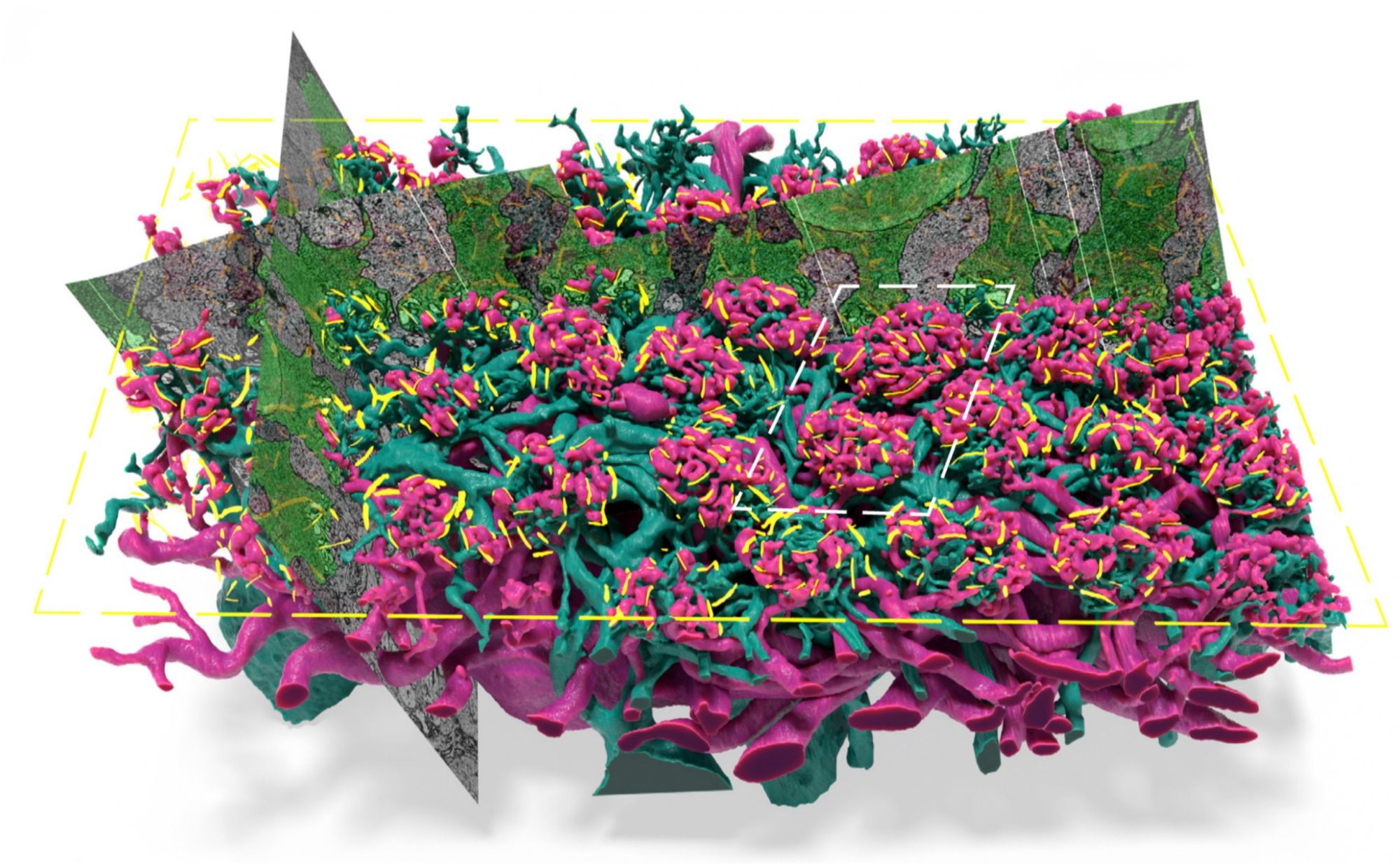
December 1, 2025 – Dr. Li Wei published a research article titled 'S-cone-specific circuitry in the outer plexiform layer of a cone-dominant mammal' in the Proceedings of the National Academy of Sciences (PNAS). Combining multiple morphological and physiological approaches—including serial block-face scanning electron microscopy (SBEM), single-cell patch-clamp recording, electroretinogram (ERG), and immunocytochemistry — the study provides a comprehensive analysis of the short-wavelength cone (S-cone) signal transmission circuitry and its modulation in the outer plexiform layer (OPL) of the thirteen-lined ground squirrel retina.
S-cones are the critical photoreceptors that capture short-wavelength light (blue and ultraviolet) in the mammalian retina, and their downstream neural circuits contribute essential visual inputs for color vision formation and circadian rhythm regulation. Due to the rod-dominant nature of most model animals and the low proportion of S-cones within the cone population (~5%), detailed characterization of their structure and functional mechanisms has remained challenging. The thirteen-lined ground squirrel retina is cone-dominant, making it an ideal model for investigating S-cone physiology.
Although individual type of cones absorb specific wavelength band of light, their output signals cannot discriminate the wavelength and intensity of light stimuli. Downstream retinal circuits must therefore compare and integrate signals from different cone types to generate color vision. Functionally, complete encoding of short-wavelength/blue signals requires cooperative interaction between an ON pathway detecting onset and an OFF pathway detecting offset of light. The ON-type bipolar cell connected to S-cones (S-cone ON bipolar cell, SCBC) represents an evolutionarily conserved cell type present across mammals, suggesting the existence of a corresponding OFF-type bipolar cell dedicated to receiving S-cone signals. However, whether S-cone OFF bipolar cell truly exists remains controversial. More critically, even within the primate-specific midget (one-to-one connection) pathway system, the presence of such S-OFF cells shows interspecies variation. Additionally, the HII-type horizontal cell in primates is currently the only known S-cone–specific horizontal cell type, whose main function is to mediate chromatic surround inhibition through negative feedback onto S-cones, contributing to S-ON/L(M)-OFF color opponency. Beyond this, in many species, certain horizontal cell subtypes extend a long axon that projects laterally within the OPL, typically targeting rod photoreceptors, yet the specific physiological function of this unique axonal structure remains unexplained.
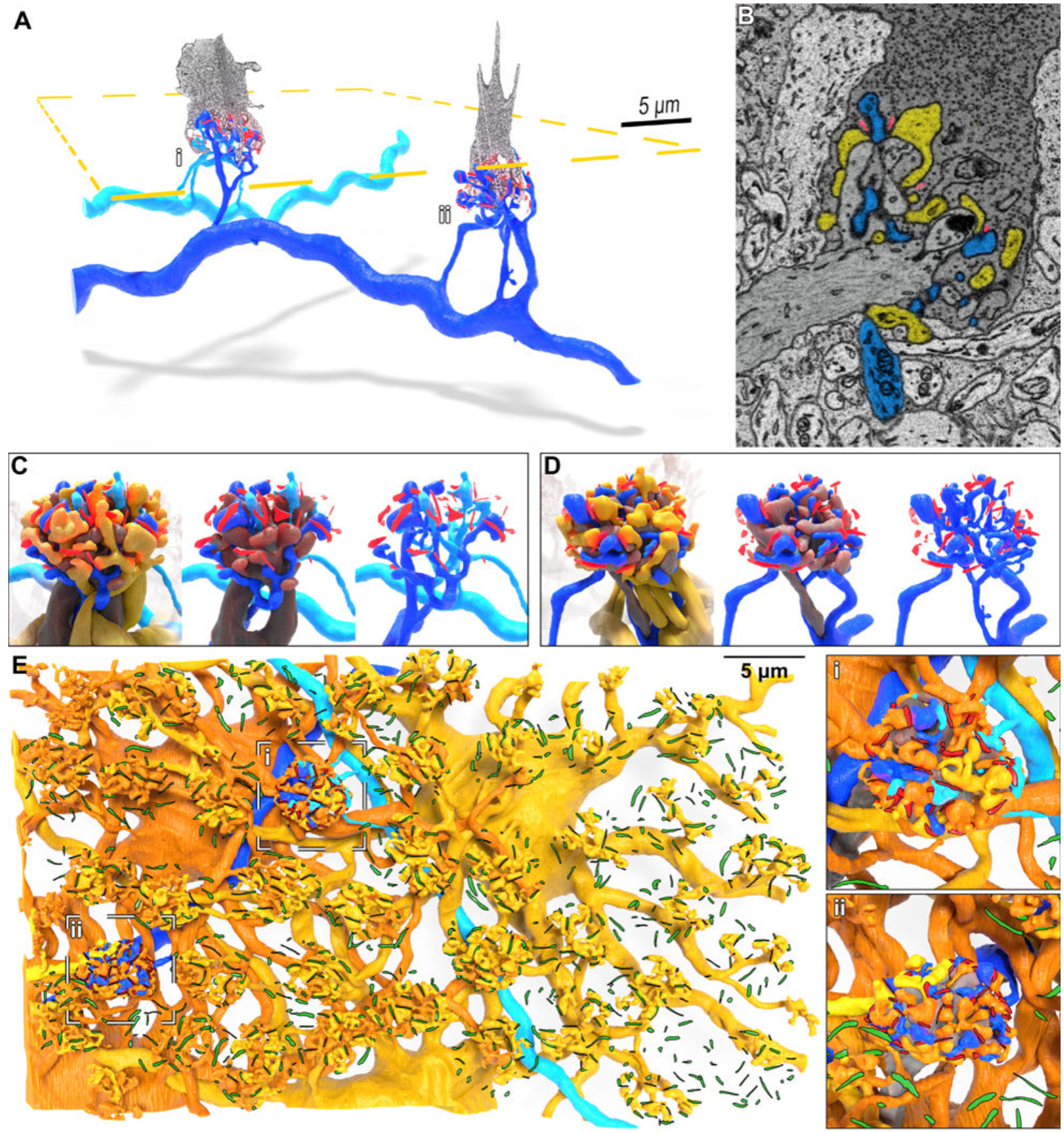
The research team first employed SBEM to perform three-dimensional reconstruction of the OPL region, precisely identifying S-cones and their synaptic connections. This analysis revealed only ON-type bipolar cells as SCBCs, with no morphological evidence for a dedicated S-OFF bipolar cell subtype. The team further validated SCBCs' ON-polarity–specific responses to blue light through electrophysiological recordings and failed to detect any light responses of S-OFF bipolar cells. Moreover, using long-term ERG, the d-wave representing OFF bipolar cell activity completely disappeared under S-cone–specific stimulation, while the b-wave representing ON bipolar cell activity increased with stimulus intensity. These convergent morphological and functional findings demonstrate that S-cone signaling in the thirteen-lined ground squirrel relies exclusively on a single ON-type SCBC pathway, further substantiating the hypothesis proposed previously by Li's team that S-OFF signals may be mediated by interneurons (amacrine cells) (Chen & Li, Nature Neuroscience , 2012), thereby refining the fundamental framework of mammalian S-cone signal transmission.
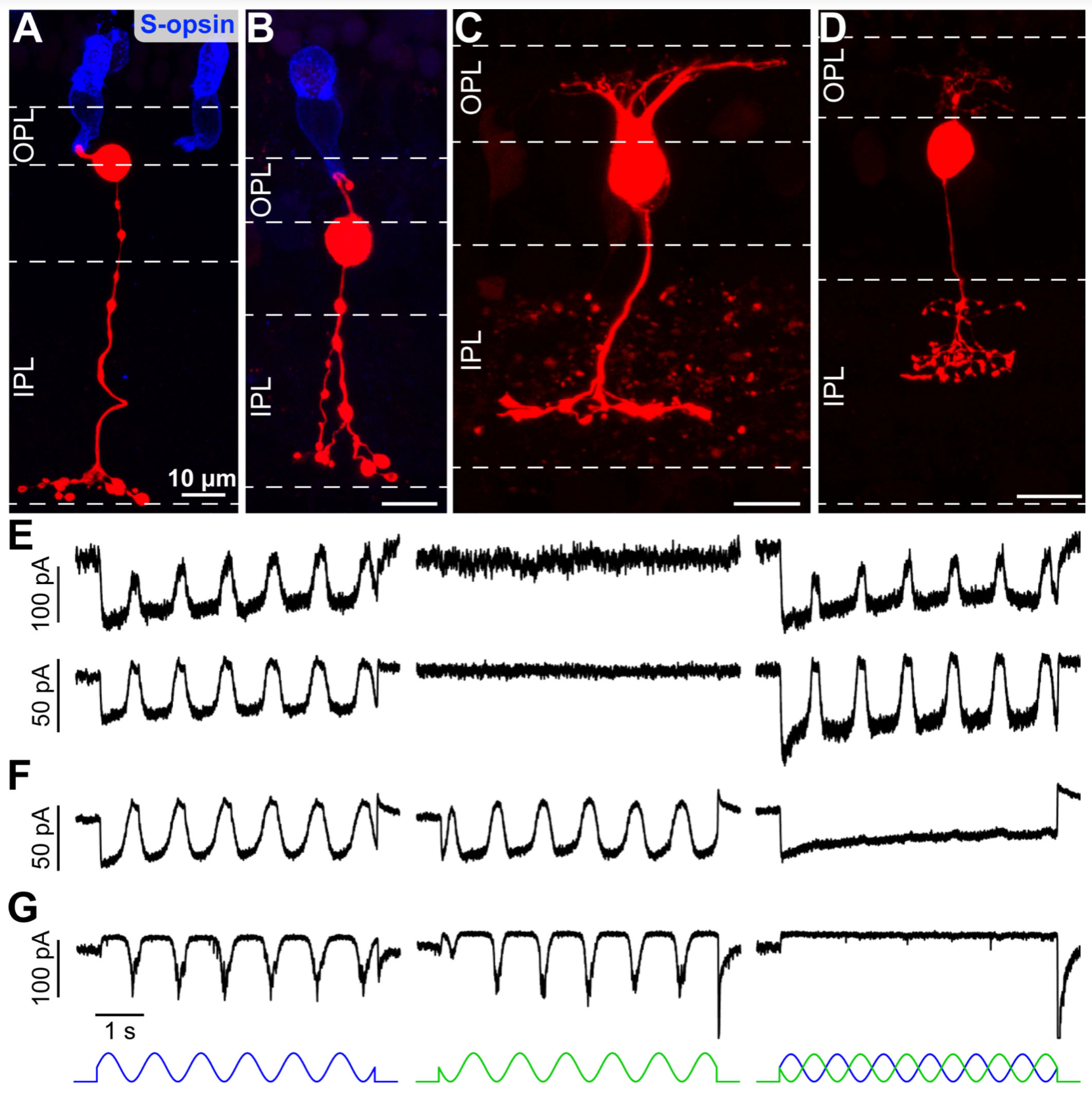
Another highlight of this study is the discovery of strict functional segregation between two horizontal cell types in the ground squirrel retina: The dendrites of H2 cells exclusively form synapses with S-cones, specifically mediating lateral inhibition of S-cone signals to enhance short-wavelength contrast. In contrast, while the dendrites of H1 cells non-selectively contact all cone types, their axons project laterally within the OPL to form a previously undiscovered dense collateral network that specifically targets long-wavelength cones while completely avoiding S-cones. This finding reveals a segregated modulatory mechanism for S- and M-cone signals, explaining how the two cone networks can independently modulate synaptic sensitivity and resolving previous controversies regarding the role of horizontal cells in color discrimination.
Collectively, the multidisciplinary anatomical and physiological evidence confirms a core characteristic of the S-cone circuitry in the thirteen-lined ground squirrel retina: S-ON signals are transmitted exclusively through ON-type bipolar cells, with H2 cells dedicated to modulating S-cones and H1 axons dedicated to modulating long-wavelength cones, forming independent signal processing channels. This discovery not only reveals a canonical pattern of S-cone circuitry in non-primate mammals (upon which primates further evolved high-resolution color vision pathways), but also establishes the thirteen-lined ground squirrel as an ideal model for studying mammalian S-cone circuits, providing critical theoretical support for understanding the effects of blue light on color vision, circadian rhythms, and myopia development.
Dr. Wei Li, Senior Investigator at NEI/NIH (currently at the SANS Institute for Neuroscience and Vision Research, Shanghai Jiao Tong University School of Medicine), and Dr. John M. Ball from Dr. Li's NIH team are co-corresponding authors of this article. The first author, Yizhen Zhang, is currently a Ph.D. candidate in the NIH-Brown University joint program and was previously awarded the Intel Science Talent Search award as a high school student for early work on this research, receiving recognition from U.S. President Obama.
Article link: https://www.pnas.org/doi/10.1073/pnas.2504954122