




Teams led by NingNing Liu and Jin-An Zhou at the School of Public Health, Shanghai Jiao Tong University School of Medicine, in collaboration with teams led by Jianli He and Jinke Cheng at the College of Basic Medical Sciences, recently published a study in Immunity entitled “Growth factor VEGF-B sustains intestinal Tfh cell stemness to restrict Taurinivorans outgrowth and microbiota-driven obesity”. The study identifies an immune–microbiota–metabolic axis through which the growth factor VEGF-B maintains the stemness of intestinal follicular helper T (Tfh) cells and limits the overgrowth of specific gut bacteria to protect against obesity. These findings provide a new conceptual basis for developing interventions for metabolic diseases through immune targeting and metabolite supplementation.
Obesity directly contributes to health problems and is closely associated with a range of noncommunicable diseases, including cancer and diabetes. Disruption of the gut microbiota plays a key role in these processes. A study published in The Lancet projects that, without urgent policy reform and action, approximately one-quarter of people living with obesity worldwide will be over 65 years of age by 2050. As this population ages, the burden on healthcare systems may increase further, with particularly severe consequences for health systems in resource-limited countries.
The researchers first found that loss of VEGFR-1 in T cells induces p53-mediated senescence in intestinal Tfh cells, reducing their numbers and impairing their function. Tfh cells play a central role in helping B cells produce immunoglobulin A (IgA) antibodies. When Tfh cell function is impaired, intestinal IgA levels decline, allowing the gut commensal bacterium Taurinivorans to escape immune control and proliferate excessively. This overgrowth depletes taurine, a key intestinal metabolite, through competition with the host. Taurine promotes fat breakdown and heat production; its depletion impairs fat burning and ultimately leads to obesity. Oral supplementation with taurine or specific secretory IgA (sIgA) can reverse this obesity phenotype.
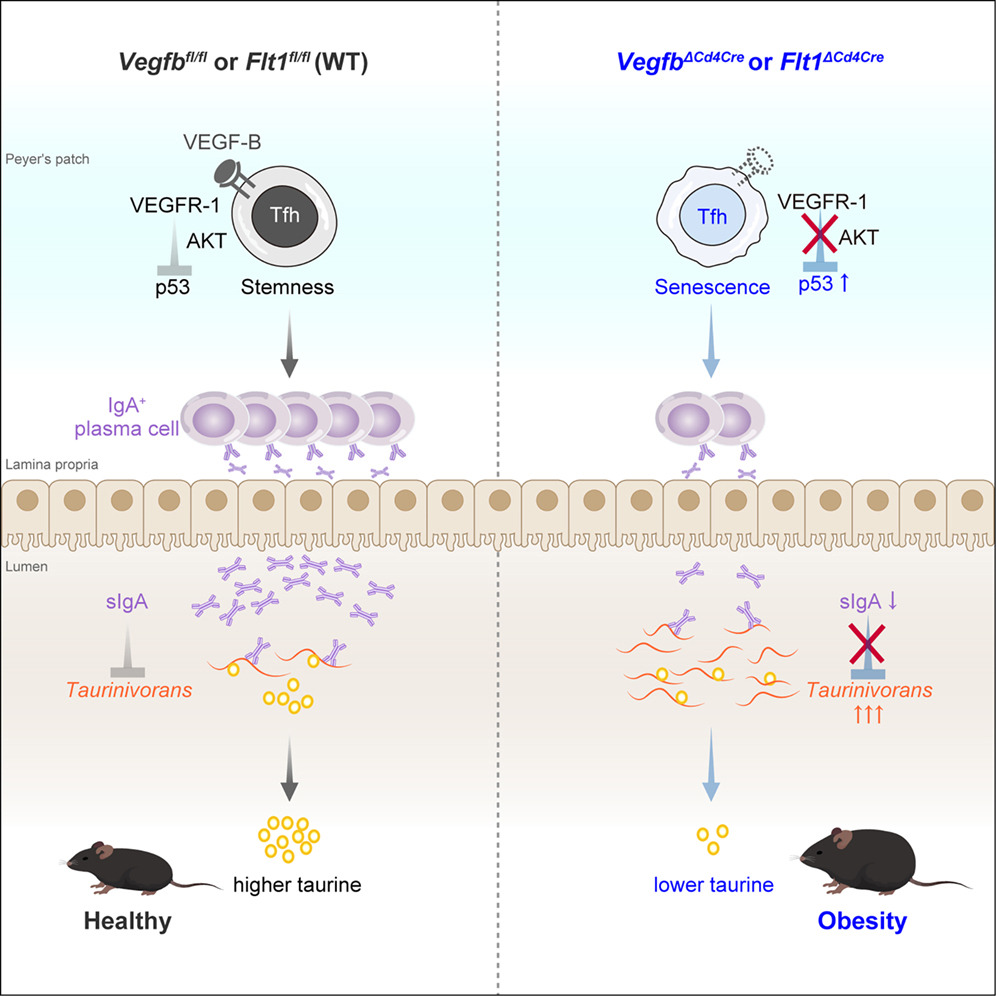
Figure legend. VEGF-B/VEGFR-1 signaling maintains intestinal Tfh cell stemness, prevents senescence and promotes IgA secretion. Loss of this signaling allows Taurinivorans to proliferate excessively, depleting taurine and ultimately leading to obesity.
To further assess the potential relevance of these findings to human public health, the researchers analyzed fecal samples from people with obesity and healthy controls. Consistent with the mouse model, people with obesity had a higher fecal abundance of Taurinivorans and markedly lower fecal IgA levels and taurine concentrations. Correlation analysis further showed that IgA levels were negatively correlated with Taurinivorans abundance and positively correlated with taurine levels.
The public health significance of this study lies in the identification of an immunometabolic pathway that can be monitored and targeted. Senescence of intestinal Tfh cells and insufficient IgA secretion may serve as early warning signs of obesity. These findings suggest that screening intestinal IgA levels and monitoring Taurinivorans abundance in selected populations, or using immunomodulatory approaches to maintain a youthful Tfh cell state, could offer new strategies for obesity prevention and adjunctive treatment.
The co-first authors are Jin-An Zhou, an experimental specialist at the School of Public Health, Shanghai Jiao Tong University School of Medicine; Jun Tu, an associate research fellow at the College of Basic Medical Sciences; and Jiang Yue, an associate chief physician in the Department of Endocrinology at the affiliated Renji Hospital. The co-corresponding authors are Ning-Ning Liu, a research fellow at the School of Public Health, Shanghai Jiao Tong University School of Medicine; Jianli He, an associate research fellow at the College of Basic Medical Sciences and the lead contact; Jinke Cheng, a professor at the Hainan Academy of Medical Sciences; and Yong Zuo, a research fellow at the College of Basic Medical Sciences.

Jin-An Zhou is an experimental experimentalist at the Center for Single-Cell Omics (CSCOmics) at Shanghai Jiao Tong University School of Medicine. Research focuses on the microbiome and human disease, with expertise in microbial isolation and culture, microbiome–host interactomics and animal infection experiments. Zhou has published as a first or co-first author in journals including Immunity and the Journal of Clinical Investigation.