




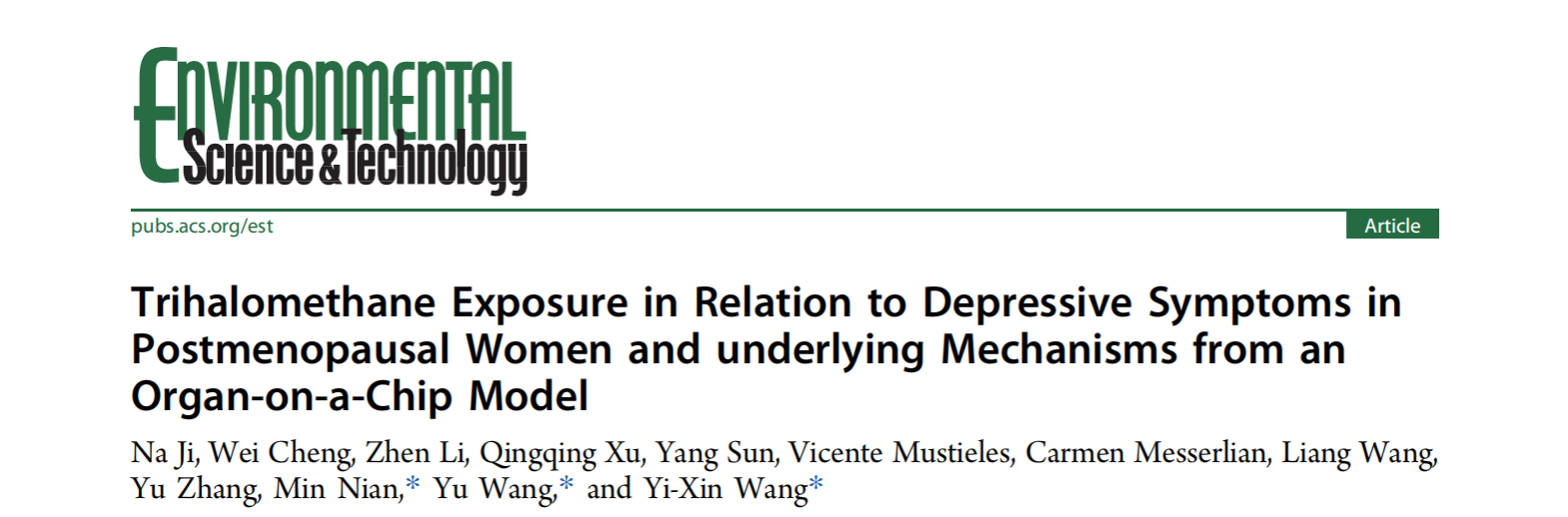
Recently, the research team led by Researcher Wang Yixin (Reproductive & Environmental Nexus for Extended Wellness, RENEW Lab) from School of Public Health, Shanghai Jiao Tong University School of Medicine, collaborated with Shanghai First Maternity and Infant Hospital, Harvard T.H. Chan School of Public Health, Marshall University and other domestic and overseas institutions to publish their latest research findings in Environmental Science & Technology (ES&T), a top international journal in the field of environmental health (Impact Factor = 12.2).
By innovatively combining population epidemiological analysis with a human-derived neuro-immune organ-on-a-chip model, the study systematically revealed for the first time that elevated exposure levels of trihalomethanes (a class of drinking water disinfection byproducts) have a significant dose-response relationship with increased risk of depressive symptoms among postmenopausal women. The research further elaborated on the potential biological mechanisms from multiple dimensions including neuroinflammation, neurotransmitter disorders and neuronal structural damage.
In recent years, Team Wang Yixin has focused on the health impacts of drinking water disinfection byproducts across the full life course. The series of studies have clarified the dose-response associations between disinfection byproduct exposure and a range of adverse health outcomes, including sperm DNA damage in males (ES&T, 2022), fetal intrauterine growth restriction (ES&T, 2021), adverse pregnancy outcomes (Environmental Health Perspectives/EHP, 2020), childhood asthma (European Respiratory Journal, 2021), reduced childhood lung function (European Respiratory Journal, 2022), decreased childhood bone mineral density (ES&T, 2023), as well as adult chronic diseases such as cardiovascular diseases, hypertensive disorders of pregnancy and thyroid dysfunction (EHP, 2025;ES&T, 2021, 2023, 2025).
These research outputs have served as critical scientific evidence supporting the formulation of China’sStandards for Drinking Water Qualityand the revision of drinking water guidelines in Canada, and directly facilitated the authoritative update of the toxicological profile of chloroform by the U.S. Agency for Toxic Substances and Disease Registry (ATSDR) and the U.S. Environmental Protection Agency (EPA).
This latest study further extends the health effect spectrum of disinfection byproducts to the neuropsychiatric health of women. It provides solid scientific evidence for environmental health risk assessment, mental health protection for women and the safety management of drinking water.
The first authors of the paper are Ji Na (2024 Master’s student), Associate Researcher Cheng Wei from the School of Public Health, Shanghai Jiao Tong University, and Associate Researcher Li Zhen from Shanghai First Maternity and Infant Hospital. The corresponding authors are Researcher Wang Yixin, Assistant Researcher Nian Min from the School of Public Health, Shanghai Jiao Tong University, and Professor Wang Yu from Shanghai First Maternity and Infant Hospital.
Other participating authors include PhD candidate Xu Qingqing from the School of Public Health, Shanghai Jiao Tong University School of Medicine, Associate Researcher Sun Yang from Shanghai Sixth People’s Hospital Affiliated to Shanghai Jiao Tong University, Professor Vicente Mustieles from the University of Granada, Professor Carmen Messerlian from Harvard T.H. Chan School of Public Health, Professor Liang Wang from Marshall University, and Researcher Zhang Yu from Peking University.
This research was funded by the National Natural Science Foundation of China (Grant No. 82473581).